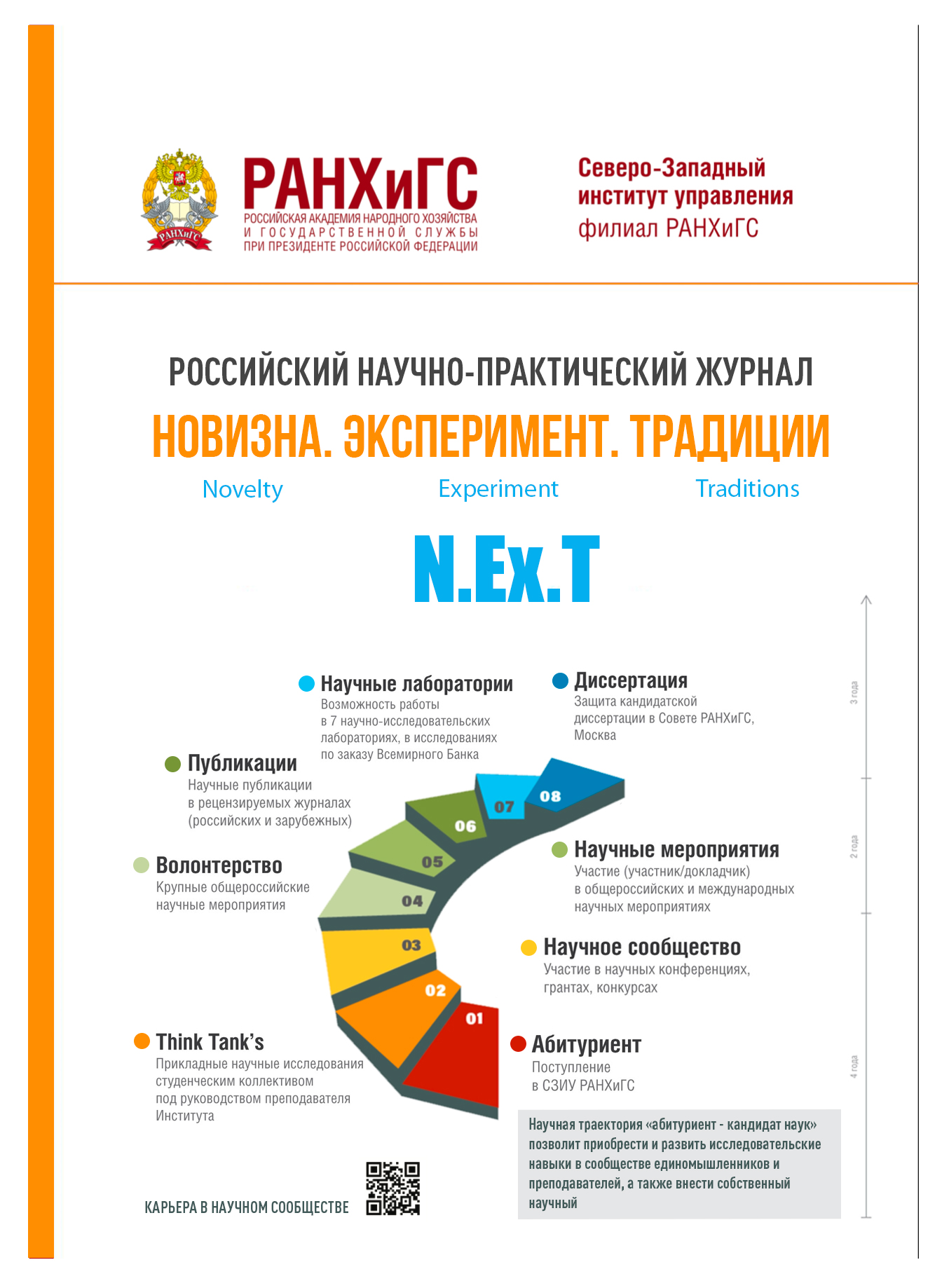
Network scientific journal "Novelty. Experiment. Traditions (N.Ex.T)"
Founder: Federal State Budgetary Educational Institution of Higher Education “Russian Academy of National Economy and Public Administration under the President of the Russian Federation”
Published in the North-West Institute of Management - a branch of the RANEPA since 2015
Registered by the Federal Service for Supervision of Communications, Information Technology and Mass Media, Certificate of Registration of Mass Media EL No. FS 77 59415 dated September 22, 2014
Registered by the Federal Service for Supervision of Communications, Information Technology and Mass Media, Registration number and date of decision to register: Mass Media EL No. FS 77 - 82820 dated February 18, 2022. Link to the register of the Federal Service for Supervision of Communications, Information Technology and Mass Media.
The certificate of registration in the National Register (for the old name "Administrative Consulting") - ISSN 2713-3230.
Certificate of registration in the National Register (for the new name "Novelty.Experiment.Traditions" (N.Ex.T)) - ISSN 2949-3625
The journal is hosted on the E-library Scientific Electronic Library platform.
Since 2020, articles have been included in the Russian Index of Science Citation (RISC).
The journal provides opportunities to publish scientific articles for students studying in undergraduate, master's and specialty programs, prepared on the basis of studies conducted in the process of academic and scientific activities in the following areas:
- Political science
- Economics
- management
- sociology
- Jurisprudence
- history
- psychology
- philosophy
- Computer Science
The journal accepts scientific articles of students in the presence of a review by a supervisor. In some cases, it is possible to publish a student's scientific article in the absence of a review by a supervisor, subject to additional review.
University professors cannot be the authors of the journal, scientific articles are not published in collaboration with the student and supervisor.
Publication in the journal for authors is free. The editorial board does not charge authors for the preparation and placement of materials.
All articles are tested by the Antiplagiarism system.
All articles undergo scientific review and referral.
The journal editors review and edit all incoming manuscripts in accordance with the established order of review.
Current issue
Introduction: As of 2026, the foreign economic activity of the Russian Federation is developing against the backdrop of the restructuring of global logistics chains and the exit of major operators, including Maersk and DHL, from the market. This change was accompanied by an increase in the share of insufficiently transparent intermediaries, as well as an increase in the likelihood of supply disruptions and restrictions on payments. The purpose of this study is to develop a systematic approach to assessing the reliability of carriers based on the adaptation of the state’s experience in categorizing participants in foreign economic activity to the tasks of the transport and logistics sector.
Methodology and materials: The study is based on a subject-oriented approach used by the customs authorities of the Russian Federation in accordance with Order No. 29n of the Ministry of Finance. The author used mathematical modeling to obtain the formula for the logistics reliability index (ILR), as well as methods of system analysis to select the weight coefficients of the criteria. The empirical base was formed by statistical data from the Federal Customs Service of Russia for the first quarter of 2026.
Results and discussion: A digital platform model has been developed that aggregates data using AI tools and calculates the ILR index. A system of ten criteria has been proposed, and compared to common approaches, the focus has shifted from financial stability indicators to operational performance, which is interpreted through the 7R principle. The weighted assessment procedure has been refined, with the highest priority given to indicators that characterize delays and route network parameters. The model includes the distribution of contractors into three risk zones.
Conclusions: The novelty of the study lies in the substantive adaptation of the customs algorithm to the specifics of logistics, which reduces the likelihood of companies with an unfavorable operational history being classified as low-risk, even if they have significant financial resources. It is expected that the implementation of the ILR index will increase the transparency of partner selection procedures and contribute to the stability of foreign trade supplies in an unstable economic environment.
Introduction: The article examines the legal issues related to the use of artificial intelligence technologies in anti-corruption activities in the context of the interaction between national legislation and international public and private law. The relevance of the study could be accounted for by the digitalization of public administration and cross-border economic processes, necessitating the development of the legal mechanisms ensuring the acceptable limits for employing algorithmic solutions in anti-corruption practices, as well as distributing legal responsibility among public authorities and private actors.
Materials and Methods: the objective of the study consists in analyzing the legal foundations for the use of artificial intelligence technologies in the anti-corruption system from the perspective of harmonizing national legislation with international legal approaches. The research materials include international and national legal acts regulating anti-corruption activities, digital public administration, and the use of artificial intelligence technologies. The study employs formal legal, comparative legal, and systemic methods, as well as the analysis of international anti-corruption standards, including the United Nations Convention against Corruption (2003), UNESCO and OECD recommendations, and the European Union Artificial Intelligence Act (AI Act).
Research Results and Discussion: It has been established that the object of legal regulation is not artificial intelligence itself, but the social relations arising in the process of applying the algorithmic systems for the detection, prevention, and investigation of corruption offenses. The author states that international standards form the basis of digital integrity, which implies transparency of algorithmic procedures, human accountability, and the possibility of legally significant oversight. It is revealed that the use of artificial intelligence technologies in anti-corruption activities is associated with the risks related to privacy violations, disclosure of commercial secrets, and algorithmic defamation. Conclusions: It is concluded that the harmonization of national anti-corruption legislation with the international legal approaches to the use of artificial intelligence technologies requires the development of the mechanisms for transparency, accountability, and independent oversight of algorithmic decisions used in both public and private sectors. The effective employment of artificial intelligence in anti-corruption activities is possible only if the procedures for legal control are normatively established, and the balance between public interests and the protection of private rights is ensured.
Introduction: Artificial intelligence (AI) technologies are rapidly permeating all еру areas of life, including education, and are becoming a familiar tool for students and schoolchildren. However, the rapid integration of AI into the educational process gives rise to certain contradictions. The paper considers the AI development background, current implementation examples, as well as some theoretical risks, and the results of sociological research.
Methodology and materials: The aim of the study is to identify the attitudes of the young people in St Petersburg towards the use of AI in education. The data collection method was a questionnaire survey. The sample was quota-based, and included the students from schools, vocational colleges and universities of Saint Petersburg.
Research results and their discussion: The study has revealed that the most popular tools are ChatGPT and Yandex services. The direct correlation was identified: the higher the level of education is, the more regular and conscious the use of AI becomes. It was confirmed that the primary advantage of AI for students is the time saved on routine tasks. However, a «skills gap» was observed: whilst demonstrating a high level of trust in textual information, the respondents showed the low ability in identifying the visual content generated by AI, indicating the overestimation of their own critical competence.
Conclusions: The young people in Saint Petersburg perceive AI pragmatically - as a useful tool, rather than a threat. The main factor shaping their attitude is practical utility. Delegating analytical tasks to AI without reflection leads to the decline in the quality of thinking, whilst using it as a «digital assistant» develops certain skills. The practical significance of this work lies in the recommendations for higher education institutions: the shift from the prohibitions to the integration of AI into the teaching process by changing the format of assignments and teaching students to interact competently with the technology. A future direction for research is the development of the methodologies for fostering critical thinking in the context of digitalization.
Introduction : The problem of domestic violence against women has been highly relevant in modern Russian society, with men accounting for 95% of offenders in this category. The persistence and the latent nature of domestic abuse necessitate the in-depth research into the offender’s personality. The objective of the article consists in conducting the comprehensive analysis of the personality of men committing violent crimes against women within the family.
Methods: The research methodology is based on the dialectical approach to social and legal phenomena, employing historical, systemic, comparative legal, and statistical methods.
Results: The study has found that the personality of a “domestic” abuser is characterized by low self-control, a high degree of pathological changes, and traumatic childhood experiences. The deficit in communication skills and the tendency toward addictive behavior were also identified.
Discussion: The findings allow for the correlation of identified traits with the existing criminological classifications, and can be applied in developing targeted prevention measures for domestic violence.
Introduction: An urgent task of regional policy consists not only in monitoring the human development index, but also in identifying key socio-economic factors determining its level. Realizing these dependencies necessitates the development of evidence-based measures to reduce inter-regional inequality and improve the quality of life.
Methods: The study is based on the analysis of official statistical data. The target indicator was transformed into a binary variable for classification tasks based on the median value. After processing the gaps and generating new features, six machine learning algorithms, including linear and ensemble methods, were trained and optimized. A stacking ensemble was additionally developed to integrate their strengths. The quality of the models was assessed using complex metrics in a test sample.
Results: Correlation analysis has revealed a strong negative relationship between the index and the level of poverty and unemployment, and a strong positive relationship with the indicators of demographic burden and economic activity. Among the models, gradient boosting demonstrated the best predictive ability, reaching an accuracy of 0.8824 and a ROC-AUC value of 0.9523. The stacking ensemble has enabled us to obtain a balanced classifier with competitive indicators.
Discussion: The results have confi rmed the effectiveness of modern ensemble methods for modeling complex socio-economic dependencies. The constructed models serve as a tool for analytical support of management decisions, providing the opportunity to assess the potential impact of changes in individual areas on the integral indicator of the region’s development. The future work will focus on providing a more profound interpretation of the models to develop specifi c recommendations.
Introduction: The institution of intellectual property in the Russian Federation has been developing and improving, as evidenced by the significant growth in intellectual property registrations with Rospatent, as well as the country’s strategic priorities highlighted in the fundamental policy documents. These factors have created the unprecedented basis for the development and advancement of domestic intellectual property platforms. The article substantiates the need to create a digital platform as the innovative tool for protecting intellectual property in Russia.
Methodology and Materials: The authors relied on the Russian and international regulations in the fi eld of intellectual property protection, the statistical data from Rospatent, as well as academic research findings. The empirical research methods were employed: the survey of the target audience, and the comparative analysis of the key players in the fi eld of intellectual property.
Research Results and Discussion: Based on the analysis of some current trends and issues in the fi eld of intellectual property, the authors put forward the idea of developing a mobile tool capable of eliminating existing economic, legal, and social barriers. The analysis of the existing competitors in the Russian market is provided, indicating their fundamental competitive advantages, and the results of the survey of the target audience are presented.
Conclusions: The development of the technologically advanced and comprehensive mobile tool for intellectual property protection is a pressing need in the Russian society. PatentUm, which has no equivalent in the Russian or international markets, could become a high-quality infrastructure solution for the new economy, where intellectual property is becoming a tangible economic asset.
Introduction: The objective of the paper is to examine the legal nature of artificial intelligence technologies, and the possibility of classifying them as legal entities. Resolving this issue is the starting point for developing and regulating the relations involving the employment of such technologies.
Methods and Materials: The study is conducted primarily from the perspective of applying the theory of human legal personality to the legally significant characteristics of AI, including its relatively high level of autonomy, and intellectual activity, its results becoming almost indistinguishable from those of humans. The research methodology utilizes both general scientific methods, including systemic and logical ones, and specific research tools, such as comparative legal and formal legal methods.
Research Results and Discussion: The study examines the potential of artificial intelligence systems to possess the status of legal entities and their potential to become equal participants in legal relations. The author analyzes the characteristics of artificial intelligence within the framework of the current “human-centered” approach to achieve the awareness of the concept of a legal entity. It has also been established that the determining factor in defining a legal personality is will, which AI does not possess.
Conclusion: Currently, it is impossible to classify AI systems as legal entities, since, although they possess some characteristics of a legal personality, they lack will. Despite their relatively high level of autonomy, AI remains technically and technologically limited, lacking the ability to autonomously set up and implement the goals.
Introduction: This article focuses on the detailed study of the current issue of the rehabilitation of the individuals who have served their criminal sentences within the criminal justice systems of various countries, which is crucial for ensuring public security, and reducing the rate of recidivism.
To achieve these goals, the comprehensive research has been conducted, involving the thorough analysis of the overseas penitentiary and post-penitentiary practices, to identify the most efficient models for reintegrating convicted individuals into society.
Methodology and Materials: The research is based on a combination of general scientific methods, e.g., analysis, synthesis, induction, deduction, description, and analogy, and specific scientific methods of cognition, including sociological and functional approaches allowing for the comprehensive study of the subject matter. Some specific methods, in particular, the comparative legal technique, played a key role in the study, as they enable to conduct the thorough comparative analysis of the criminal justice systems and legislative mechanisms of various jurisdictions. As the element of the comparative analysis, the approaches used in the criminal enforcement practices of the United States of America, the French Republic, Canada, the Federal Republic of Germany, and the Swiss Confederation have been closely studied and systematized. The study covers both the general principles of the functioning of penitentiary institutions, and specific measures aimed at social adaptation, deradicalization, and prevention of recidivism among individuals released from places of detention, including post-prison support programs, and specialized “re-entry programs.”
Research Results and Discussion: The results of the study demonstrate a significant variety, and proven effectiveness of the overseas approaches to rehabilitation. The study identifies the best practices characterized by their complexity, the focus on the goal, as well as the high level of humanization, which confirms their relevance and feasibility in the context of modern penitentiary reform. Special attention is given to the measures aimed at overcoming the stigmatization of former convicts, developing their professional skills, forming a stable anti-criminal attitude, and integrating them into public life.
Conclusions: The practical significance of the work consists in developing the substantiated recommendations for optimizing the Russian penal system, and relevant legislative acts. The measures proposed, based on foreign analogues, include improving the legal regulation of resocialization processes, and introducing innovative approaches to working with former convicts. The purpose of these recommendations is to increase the effectiveness of preventing recidivism and ensuring the sustainable reintegration of released individuals into the legal and social space of the Russian Federation.
Introduction: The paper presents the comprehensive analysis of the illicit trafficking of cultural property as a manifestation of the crime that causes irreparable damage to cultural heritage, historical memory, and international security.
Methods and Materials: The methodological basis of the study involves the general dialectical method of cognition, along with the extensive employment of comparative legal, formal legal, historical legal, concrete sociological, and systemic-structural methods, which is accounted for by the interdisciplinary nature of the work integrating the methodological approaches traditionally employed in legal science, and the methods of criminological analysis focused on the study of crime, its causes, and preventive measures.
Results: The key gaps in the international legal and national regulation have been identified: the lack of the consistent definition of cultural property, the impossibility of retroactive application of the 1970 UNESCO Convention, fragmented law enforcement, and the difficulty of proving the legal origin of artifacts. It has been established that the digitalization of the black market (the use of social networks, online auctions, the darknet), and its integration with organized crime and terrorism reduce the effectiveness of traditional control measures. On the example of the Russian Federation the low effectiveness of criminal prosecution under Article 243.2 of the Criminal Code of the Russian Federation has been substantiated resulting from the high latency of these crimes, and the objective difficulties in p roving the elements of the offense.
Conclusions: It has been substantiated that national legislation needs harmonizing on the basis of consolidated international standards, creating and implementing international digital provenance registries (using blockchain technology), significantly enhancing interstate operational and technical cooperation, including joint cyber patrolling, as well as developing legal archaeology and public oversight.